MonsterCare_Core_Design_v0.3
MonsterCare: Core Design Document
(working title, rename pending)
v0.3, working draft, June 22 2026
1. Concept
One line: a cozy game about reading forgotten imaginary friends well enough to help them remember who they were, and, in doing so, help the player heal too.
You play Sparky, an imaginary friend who is stuck in the in-between. He's stuck because he has forgotten something important: his own goodbye. He can't remember letting go of his own child, and that unfinished farewell is what keeps him here. Rather than sit with it, he opens an inn for others who are also stuck: forgotten friends who were left behind when their children grew up.
Guests arrive at the inn with their memories blurred by the journey to the in-between. They half-remember feelings and fragments but not the shape of who they were. The player's job is to care for each guest, learning them, giving them what they need, and through that care helping their memories return: small likes first, then the child they belonged to, then the heart of why they mattered, until they reach the acceptance that lets them move on. A "completed" monster does not die or dissolve. They return to the human world, where a new child has imagined them again. As Sparky helps others remember and let go, he slowly recovers his own story. The game ends when Sparky, having reached his own catharsis, is finally free to go find his next kid.
The emotional register is renewal. Nobody is dead; everybody is going home. We never state on screen whether Sparky's child grew up or died: the emotional truth (a bond ended and he couldn't accept it) is identical either way, and the ambiguity keeps the tone understated.
2. Pillars
- Intimate caregiving. The fundamental verb is "read a specific being and provide for them." Every system is an expression of that.
- Memory and remembering. Guests arrive hazy and recover their pasts through the player's care. Remembering is how the player comes to know a guest, how their story advances, and, across the whole game, how Sparky comes to know himself. Memory runs through all of it: the guest layer, the act of caregiving, and the protagonist's arc.
- Renewal, not loss. Letting go is a beginning. This is the emotional center of the game and its marketing identity.
- Understated grief. Heavy themes are hinted, never delivered bluntly. Comedy and warmth carry the surface; the ache is underneath.
- Small and hand-authored. A curated cast of hand-crafted characters. Quality over quantity. No procedural generation, no endless mode.
- Cozy with gentle friction, no fail-state. There is choice-pressure (limited time, scarce ingredients, a past to piece together) but never failure that makes a beloved character disappear without closure.
3. Differentiation
We sit at an intersection nobody currently occupies:
- vs. Spiritfarer: they're about death and finality (the player is literally Death's helper, the Everdoor is goodbye forever). We're about renewal (guests go home to a new child). More hopeful, cyclical, ownable.
- vs. IF (2024) / Foster's Home: they share the forgotten imaginary friend premise but are about rehoming and episodic comedy. We're the slow, intimate, care-then-release loop. The intimacy is the difference.
- Protagonist as the deepest arc. Most caretaker-sims give the player a cipher: the blank avatar of Animal Crossing or Stardew Valley. Even our immediate references keep the carer at arm's length (Cozy Grove's anonymous Spirit Scout, Spiritfarer's silent Stella). Here the caretaker carries the central mystery, resolved through the act of caregiving itself.
- Empathy as reconstruction. The core verb is helping a half-erased person remember who they were. Compare the diagnose-and-route loop of Two Point Hospital, or the need-bar management of The Sims. "Every guest is a small mystery of the heart to piece back together."
4. The core loop
Everything below is a facet of one loop. Hold it as a design test: if an action can't trace back to a specific monster the player is trying to understand, question whether it belongs. Every action serves a guest the player is getting to know, e.g. the player grows lilies because Murmur is starting to remember he loved them.
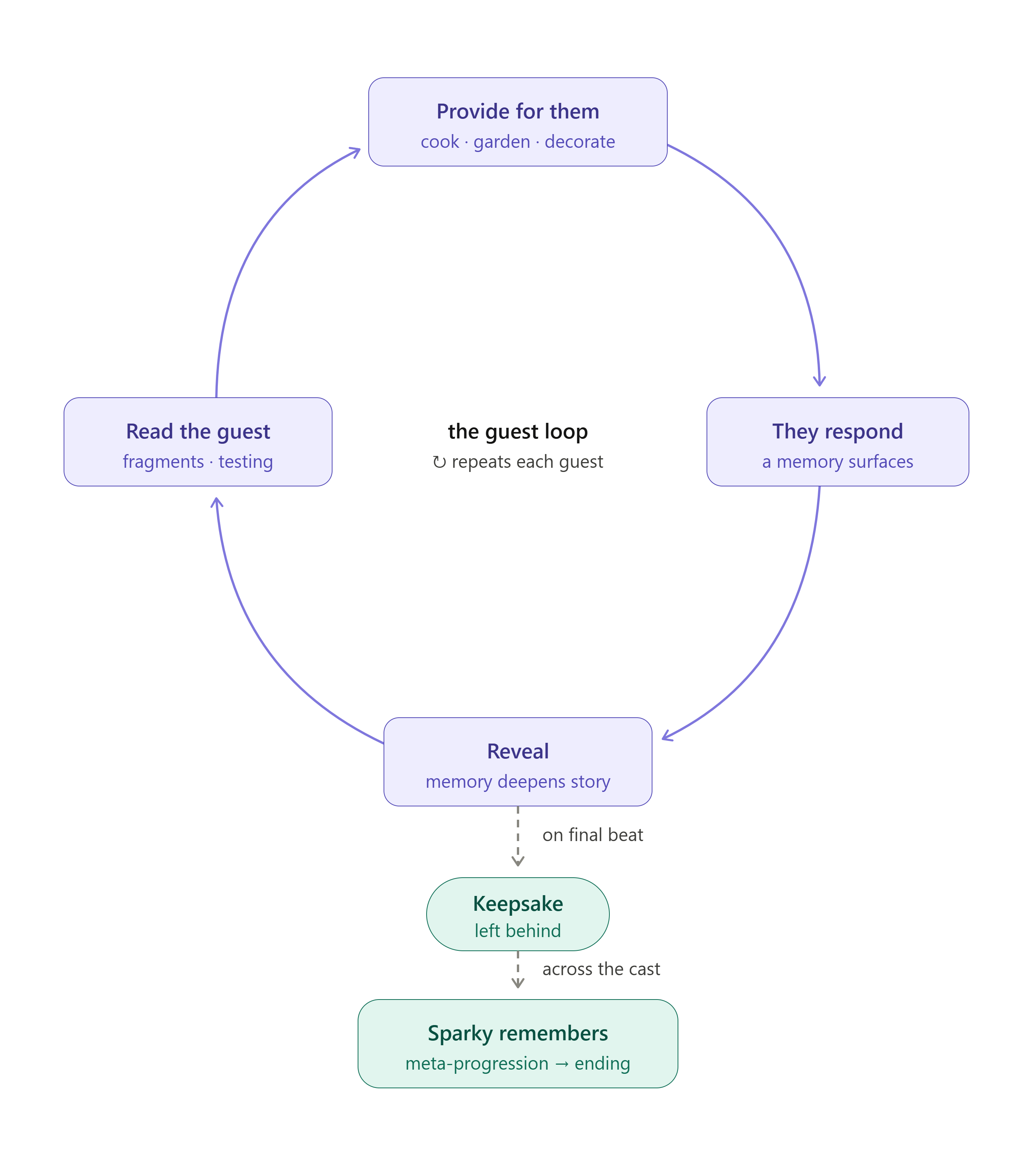
The reward is never money or score. It's the reaction, the memory that returns, and the next chapter it opens.
5. The verbs: systems as expressions of the loop
Each verb serves one preference axis (§6) and has a deliberate cadence. Each is also a way of jogging a memory loose: the right meal, the right room, the right activity is often what makes a hazy guest suddenly recall something.
- Cooking → Flavor. Daily rhythm. Breakfast and the evening or happy-hour drink are recurring care rituals. Light, hands-on minigame (cooking-pot style; cocktail mixing as a variant).
- Gardening → supplies and Vibe. Daily rhythm. Grows ingredients for cooking and themed flowers and plants for decorating. Plant, water, multi-day growth. This is the renewable production base.
- Decorating → Vibe. Per-monster milestone, not daily. Once a room matches a guest, that content is done, so decoration marks the "I finally understand you" beats. Don't make it the main sink; it has a completion problem.
- Activities → Activity. Scheduled. Basic yoga and meditation are free (Tier 0); richer activities such as spa or music therapy are gated by the ability tree (§8). Presented mostly as short vignettes or dialogue rather than real-time minigames (?)
- Tidying → Comfort baseline. Ambient. Mess and breakage appear over time and lightly suppress mood until cleaned. Guests will comment on the cleanliness. Kept deliberately small and tactile.
Cadence summary: cooking and gardening carry the day; decoration and activities mark the beats; tidying is ambient texture.
6. Memory and preferences as the puzzle
There are 4 major actionable preference axes, each tied to a verb so no preference is ever noise:
- Flavor (cooking): sweet, savory, spicy, sour.
- Vibe (room decorations and garden flowers):
- Palette (warm, cool, muted)
- Texture (soft, natural, sleek)
- Motif (night, guardians, rockets)
- Activity (scheduling): what they enjoy doing - yoga, book club, crafts etc.
- Comfort and environment (where they linger, room ambiance): light vs. dark, cozy vs. open, quiet vs. loud etc.
The fiction: guests have genuinely forgotten their preferences. Memory is fogged by the journey to the in-between, and the small likes and the deep backstory blur from the same cause. So the discovery loop has one clean explanation: the player is helping a foggy guest reconstruct themselves.
Keep remembering active. The "care unlocks memories" could potentially slide into "care generically, wait for a memory to drop, comply," which would flatten the puzzle into a passive timer. The rule: the player's actions are the trigger. A guest half-remembers a feeling ("there's a smell I can't place, something warm") and the player experiments until the right thing makes the memory click. Their guesses drive it.
3 discovery channels, each able to surface a memory:
- Fragments: half-memories and feelings the guest lets slip ("it was quiet where I came from... no, the opposite").
- Observation: where they choose to linger (a guest drifting to the dimmest corner is telling the player something).
- Testing: trying a dish, a room change, or an activity and reading the reaction. A wrong guess isn't wasted: it can still jog a fragment ("that's not it, but it reminds me...") and narrow the search.
The Memory Book holds this: suspected feelings beside recovered memories, filling in as the player pieces each guest together.
Preferences and backstory are one thread. A remembered like is tied to the child. "Murmur loves the sound of frogs" is the loose end of "Noah whispered to him at night." Pulling the small preference brings the larger story with it. So the 4 axes are the way into the 5 emotional beats (§7).
The archetypes are kinds of forgetting, which deepens them and gives each a distinct puzzle texture:
- Open Book: remembers readily but jumbles it with jokes to dodge the ache, the obvious reading is a trap.
- Guarded: memories stay foggy because they hurt, needs baseline comfort before they return.
- Logical: recalls facts but not feelings, needs help processing what he remembers.
- Chaotic: fragments surface out of order, so his preferences seem to shift.
A wrong provision never punishes. It gives a gentle, funny reaction and a clearer hint. The player should be incentivized to try things, and not hate guessing incorrectly.
7. Emotional progression and relationships
Each guest moves through 5 beats, each a stage of remembering:
- Guarded Introduction: haziest; only fragments and feelings, with the first surface preferences beginning to return.
- First Vulnerability: a small, concrete memory surfaces.
- Deepening Bond: more memories; the child comes into focus.
- The Emotional Core: the central memory. Why they existed, the role they played, and the painful turn of being outgrown.
- Acceptance and Farewell: the full memory returns, and with it peace; they're ready to go home.
Reading a guest correctly is what advances their story. The player earns beats by helping the guest remember; there is no clock to grind. The early surfaced preferences (§6) are the way in, and the activities and care that suit a guest are what jog the deeper memories loose.
Remembering carries a cost. Beat 4 is the painful one (the moment they were outgrown), so the arc builds toward a memory that hurts. That gives it stakes and stops it from being a stream of pleasant memories with no weight.
Conversation choices are Persona-style and influence attachment. Dialogue choice consequences are additive and never catastrophic. A "weaker" choice means a missed nicety or slower warmth, not a damaged relationship. But if the player says the right things, they could find out something unique about the character.
8. XP and abilities: soft-lock-proof structure
XP is earned by crossing emotional beats (helping a guest reach the next memory) and spent on abilities (cooking techniques, music, massage, crafts) that open new activities. The danger is circular: activities gate beats, beats fund abilities, abilities gate activities. To make stranding structurally impossible, the tree follows these rules:
- Tier 0 is free. Basic meals, placing furniture, basic tidying, basic gardening, and basic yoga and meditation, available from the start (introduced with the tutorial) with no XP. Tier 0 alone satisfies baseline comfort and reaches Beat 1, ideally Beat 2, of every guest.
- Early beats need no abilities. A guest's Beats 1–2 never require a purchased ability, only baseline care, conversation, and the easy early memories.
- Gated beats are funded early. Later beats may need an ability, but those abilities are paid for by anyone's early beats. There is always an XP-income path that doesn't depend on the ability the player is buying.
- No circular single-source dependency. Never let an ability be required by exactly one beat that is itself the only source of XP for that ability.
- Numerical guarantee. The XP available from ability-free beats across the full cast must exceed the total cost of every ability needed to finish everyone. Validate this in a spreadsheet once the cast and beat list are locked.
Crossing a gate surfaces a memory (see the MonsterCare_XP_Dependency_Map companion for the initial calculation).
9. Keepsakes and the two memory tracks
There are 2 memory-recovery tracks, kept separate:
- The guests' memory is restored during their stay, through the player's care (the per-guest loop above).
- Sparky's memory is restored across the whole game, through the keepsakes guests leave when they depart.
When a guest departs they leave a keepsake. It has 2 uses, kept separate:
- Expressive (the rule): each keepsake adds something optional and commemorative, themed to that guest: a decor set, a recipe, a flower, a song (Grumble's flashlight gives nighttime ambiance and lighting). This keeps keepsakes off the critical path (no soft-lock risk, near-zero dependency planning) and makes the inn grow richer as guests leave, which answers our "empty late-game" worry. It fills with traces of everyone the player has helped.
- Structural (one use only): the collection of keepsakes gradually brings back Sparky's own memories and leads to the ending. It is more than a counter: each guest's recovered memory resonates with Sparky's and surfaces a matching fragment of his own (helping Kruggle remember being a child's bedtime guardian stirs Sparky's own bedtime memory). His memory is the most buried and returns last, after he's helped everyone else, fitting since his own goodbye is the hardest one.
Avoid making keepsakes functional progression gates. Beyond the soft-lock risk, it creates the grotesque incentive of needing a guest to leave to get a reward, which poisons the tone.
10. No-money Economy
There is no money, grants, ratings, or day-rate. The economy is time, garden yield, and delivery lead-time, with the inn and its grounds as the entire world. Explorable gather locations?
- Garden and greenhouse: renewable production (most food and themed flowers), gated by space, water, and grow time.
- Deliveries: these supply everything the player can't grow (furniture, building kits, exotic ingredients, preference-specific decor). Gated by next-morning lead-time and a small daily order-slot count, not by cash. The delivery beat gives the day a rhythm, and the delivery monster can become a recurring character with no full grief arc.
- Don't let the player grow or make everything. The gap between "what I can produce now" and "what this guest needs" is the planning friction that makes the loop engaging.
- Let the dreamlike setting solve realism. In a liminal in-between, materials can simply arrive, and the garden can grow things that don't quite exist in the human world. This sidesteps "who funds this" entirely.
11. Day structure and monster AI
The day runs as paused bookends around a real-time middle: a Persona-style rhythm of calm prep, busy day, calm wind-down. Time only ticks during the daytime. Morning and evening are paused, and the player leaves them by choice.
- Morning (paused). Guests are asleep, so only new arrivals and prep are available: deliveries, stowing, gardening, room-building and decorating, scheduling the day's activity, ordering. It flows from prep into breakfast: ring the bell, the guests wake and gather in the canteen, and the communal meal closes the morning before the day begins. (Prep and breakfast run as one flowing block.)
- Daytime (real-time). The only ticking phase. Guests free-roam and react to their environment; the player cooks, gardens, decorates, tidies, chats, and preps and runs the scheduled midday activity. This is where moment-to-moment play and the day's time-pressure live.
- Evening (paused, locked to the lounge). Everyone gathers for cocktails and conversation, and the deepest, most intimate beats land here. Keep the lock soft: the evening waits for the player instead of fencing them in, so a forgotten daytime task is just tomorrow's problem.
- Night (occasional, story-gated). A triggered beat, not a daily slot: a guest waking the player to say they're ready, a fragment of Sparky's own memory surfacing, a "can't sleep" moment.
- Tutorial exception: the first day traps the player in a front-desk time bubble until the core prep beats (shipment, calendar and activity, guestbook) are handled, then opens up.
Tuning knob (not yet locked): whether the paused phases are fully free (do everything at leisure) or lightly budgeted (can't do everything in one morning, forcing prioritization). This decides whether engagement-pressure comes from the daytime and resource limits alone, or also from a per-phase action budget. Lean cozy and free unless the paused phases start to feel like flat to-do lists.
- Meals are paused care rituals.
Monster AI runs on routine and reactivity. This is what resolves the "alive but cozy" tension:
- Guests follow light daily schedules (Animal Crossing-style) and react to their environment: they linger in spots they like and comment on a fresh rug or a mess.
- No draining bars force replenishment behavior. Guests feel alive through routine, environmental reaction, and ambient barks.
- This is why paused meals don't clash: meals are scheduled rituals, and daytime is guests living their routines and reacting to the world the player has shaped for them.
Seasons are a visual and narrative device only: lighting, mood, occasional beats.
12. Scope and cast
- 5 guests total No endless mode and no modular or procedural monsters.
- Dialogue: "animalese"-style talking is the leaning default. Full VO is likely a no (decide at pitch; it's a budget line that dwarfs almost everything else).
- Story and lore: the writing is the product. Each guest needs a full 5-beat memory arc, generic interaction pools (per topic, per mood), activity reactions (poor, neutral, good), meal and drink dialogue, repeat lines, a 4-axis preference set with the memories opened by key entries, a keepsake, a resonance with Sparky's own story, and a unique farewell.
13. Non-goals and scope boundaries
To stay finishable for 2 people and to protect the intimate, hand-authored feel, the following are deliberately out of scope:
- A multi-axis wellness or ailment-diagnosis puzzle. The puzzle here is memory recovery (§6).
- Procedural or modular guest generation. The cast is hand-authored (§12).
- A needs-depletion simulation, or player-facing need bars (hunger, hygiene, social, and so on). The only environmental factor is light Comfort. Guests feel alive through routine and reactivity (§11).
- Money, grants, ratings, day-rates, and a seasonal economy. Resources are time, garden yield, and delivery lead-time (§10).
- Booking, walk-in denial, and capacity penalties. Guests arrive as scripted walk-ins at narrative beats.
- Competition and marketing systems.
- Player stamina.
- Endless mode.
- Multiple explorable gather locations. The inn and its grounds are the entire world (§10).